

Lover's Eyes
The Erotic Quality of Portrait Jewelry

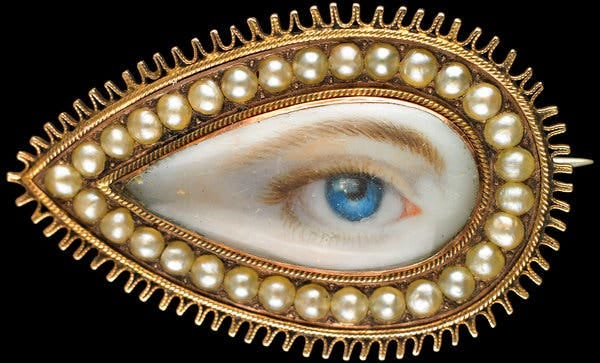
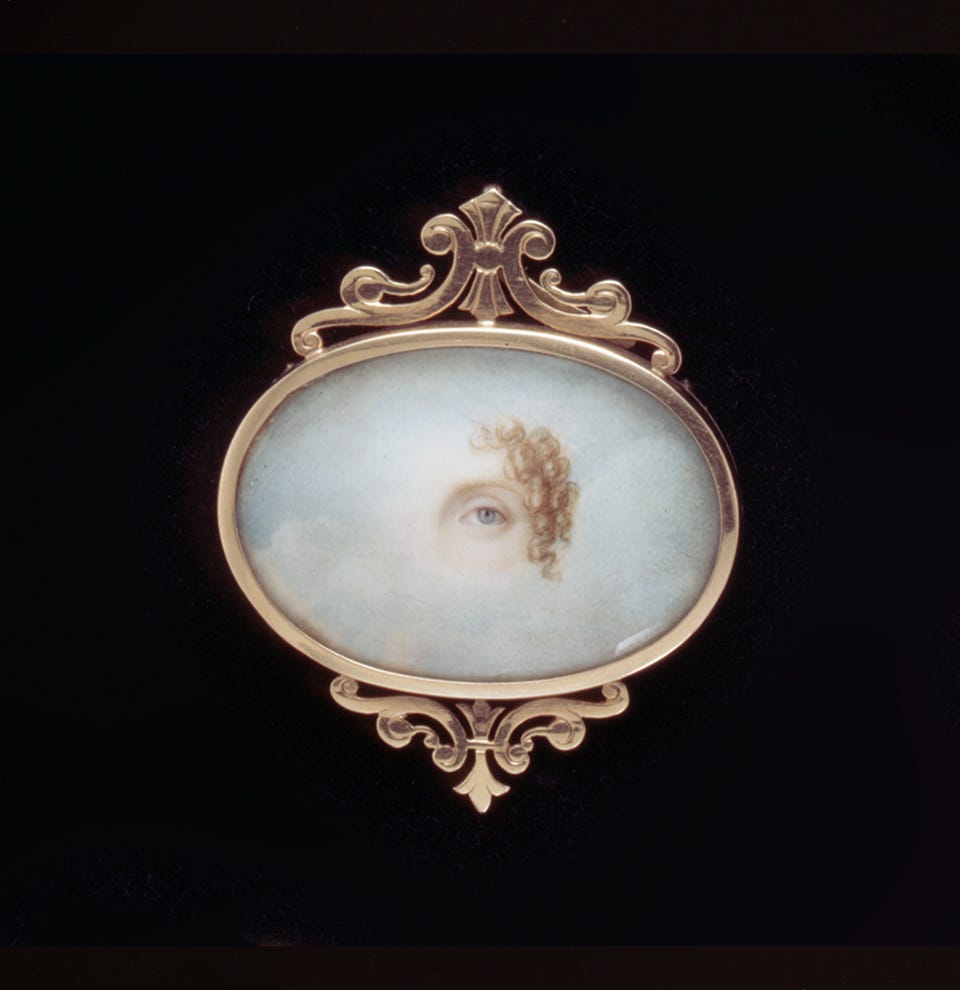
Eye miniatures, now called Lover’s Eyes, became popular in 18th Century England when The Prince of Wales (future King George IV) fell in love with a twice-widowed Catholic six years his senior, Maria Anne Fitzherbert. Their love was forbidden - royal laws forbade a Catholic from becoming a monarch. Despite this, the prince proposed that she become his mistress. Fitzherbert refused and fled to Paris to avoid controversy. Soon after, she received a letter and a gift, “I send you a parcel and I send you at the same time an Eye.” Inside was a very small painting of George’s own right eye surrounded by jewels. Soon after, in December of 1785, the lovers wed in a secret ceremony. Another eye was then painted - this time Fitzherbert’s - which was nestled into a locket for the prince to carry under his lapel.
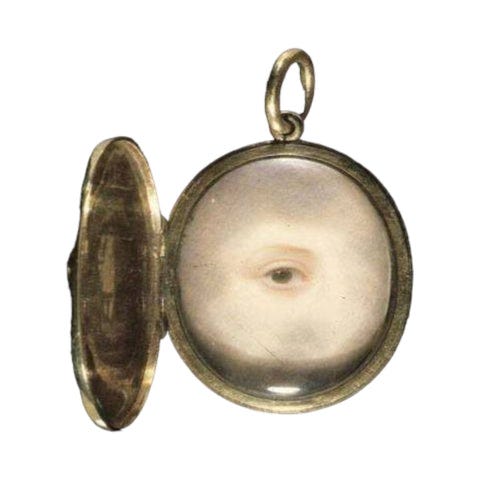
Their marriage was not publicly acknowledged and invalid under English civil law. Despite this, the couple lived together for many years. Eventually George became overwhelmed with his debts and had to appeal for help. Parliament agreed to clear his financial burdens if he was to marry a Protestant. In 1795, he reluctantly wed his cousin, Princess Caroline of Brunswick. Their marriage was miserable and they quickly separated in 1796 after the birth of their first child. George remained attached to Maria Fitzherbert for the rest of his life. In his will he requested that “my constant companion, the picture of my beloved wife, my Maria Fitzherbert may be inter’d with me suspended round my neck by a ribbon as I used to wear it when I lived and placed right upon my heart.” His Lover’s Eye was indeed buried with him after his death in 1830.


This illicit and high profile royal relationship caused the eye miniature to become popular in England for the next 50 years. The tiny ivory paintings surrounded by jewels took the form of pendants, rings, lockets, brooches, and other pocket-sized trinkets. Some were commissioned as gifts to express devotion to their loved ones, while others were painted in memory of the deceased. Often times, a lock of hair would be sealed onto the other side of the piece. About 1,000 Lover’s Eyes were painted in England between the 1780s-1830s.
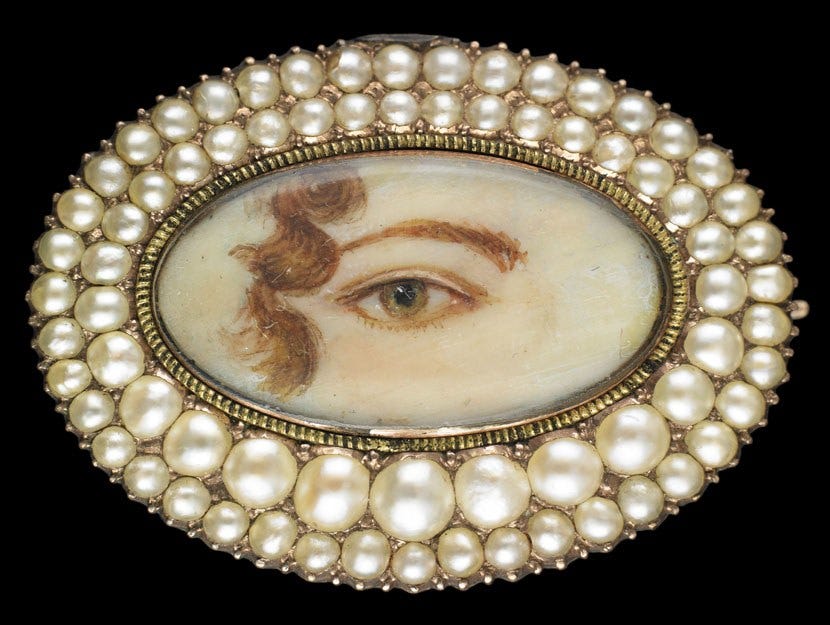
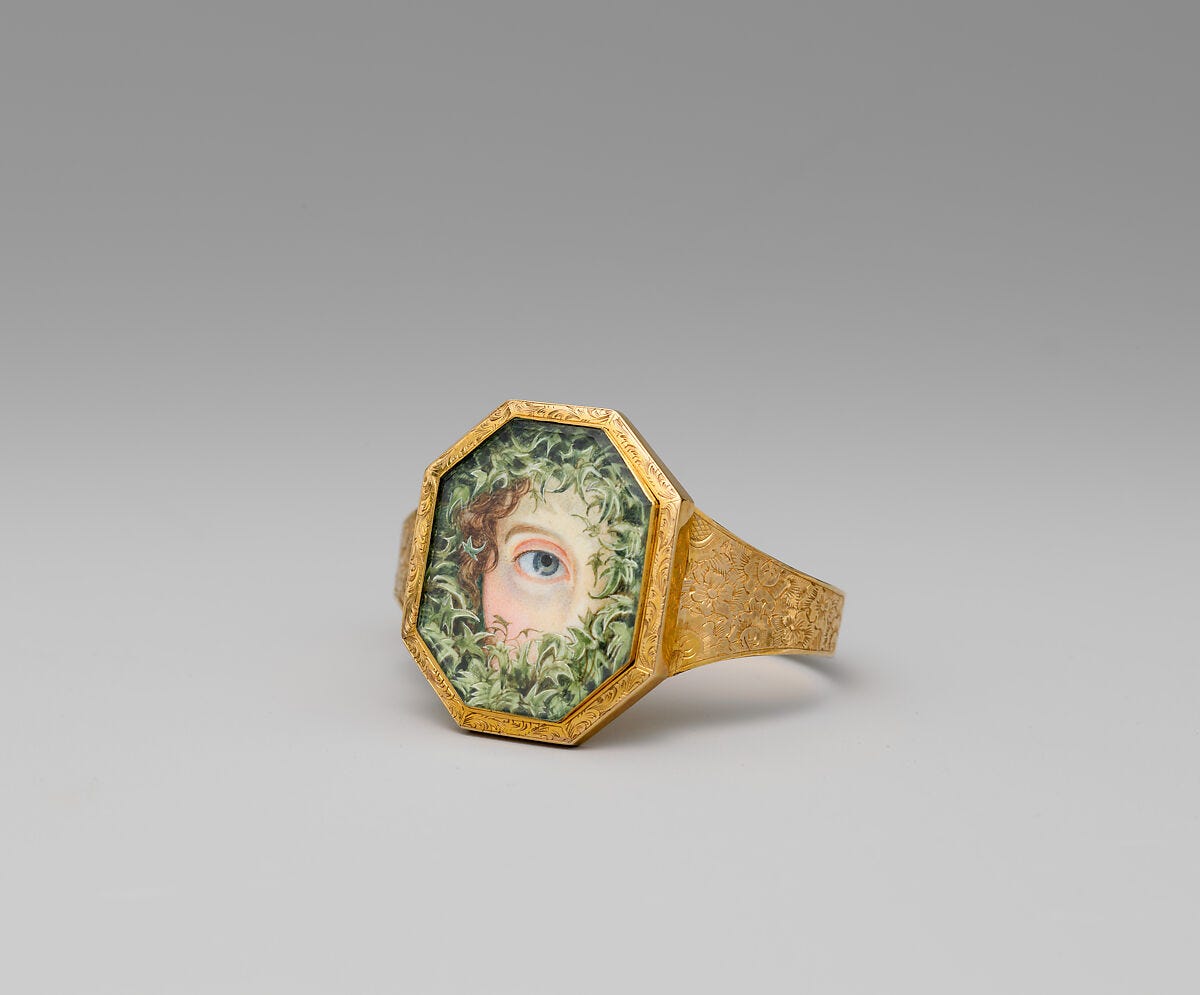
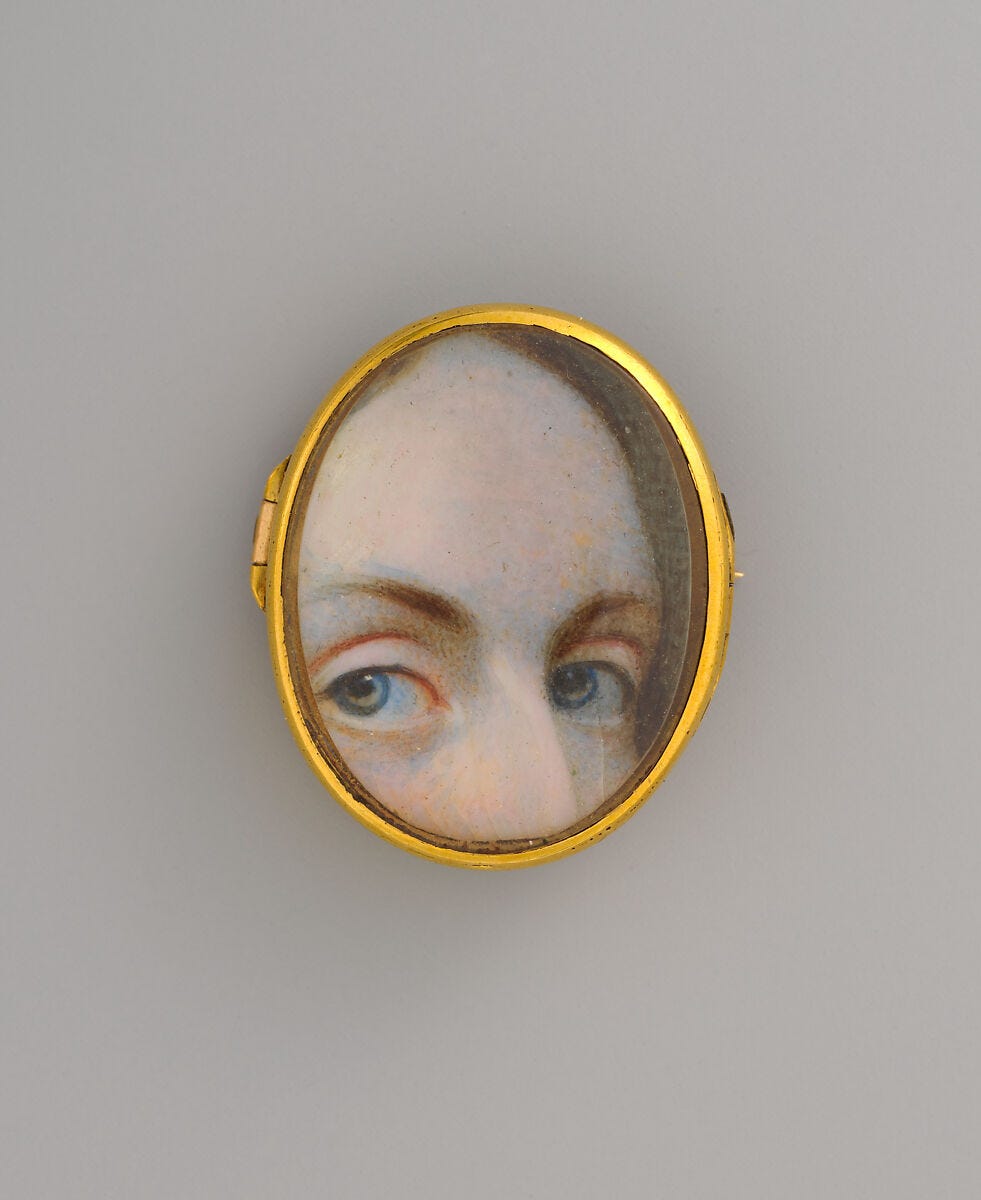
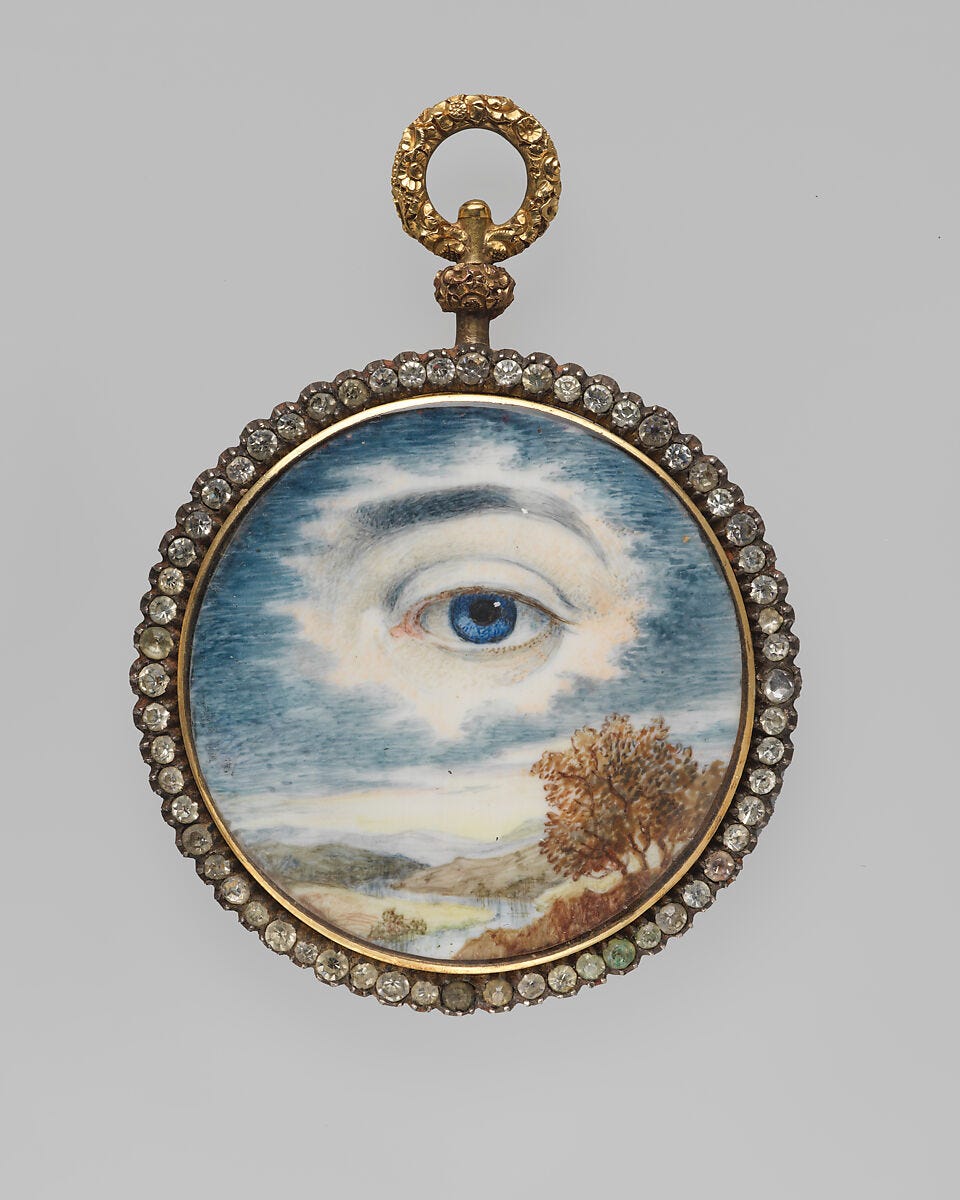
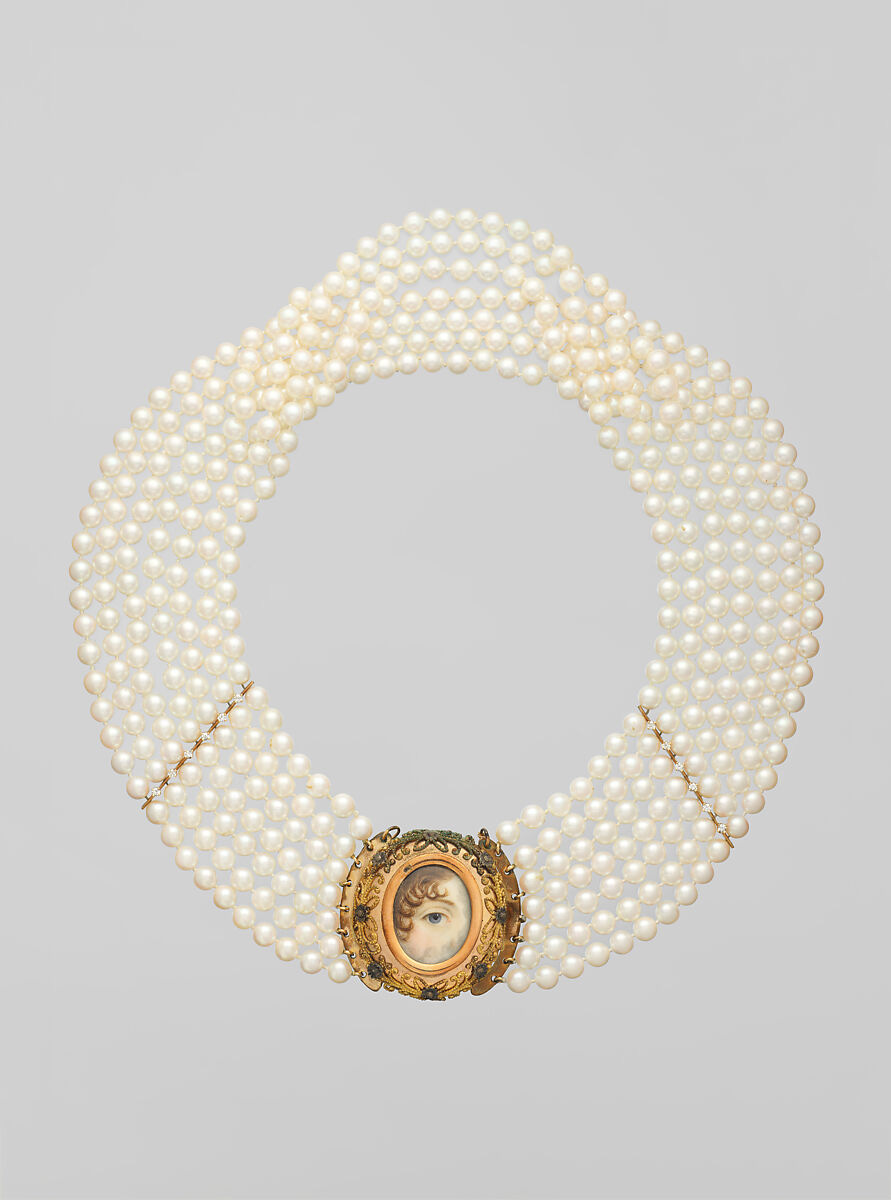
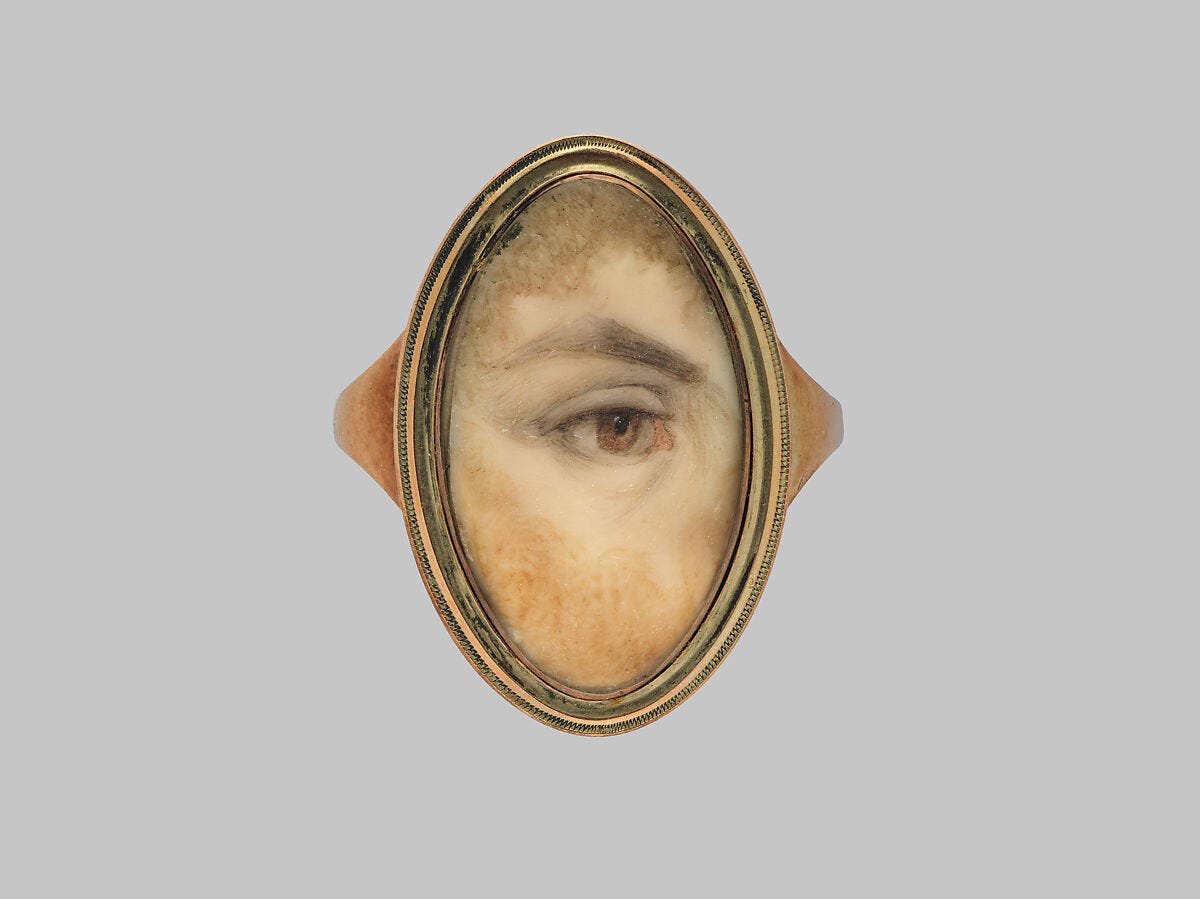
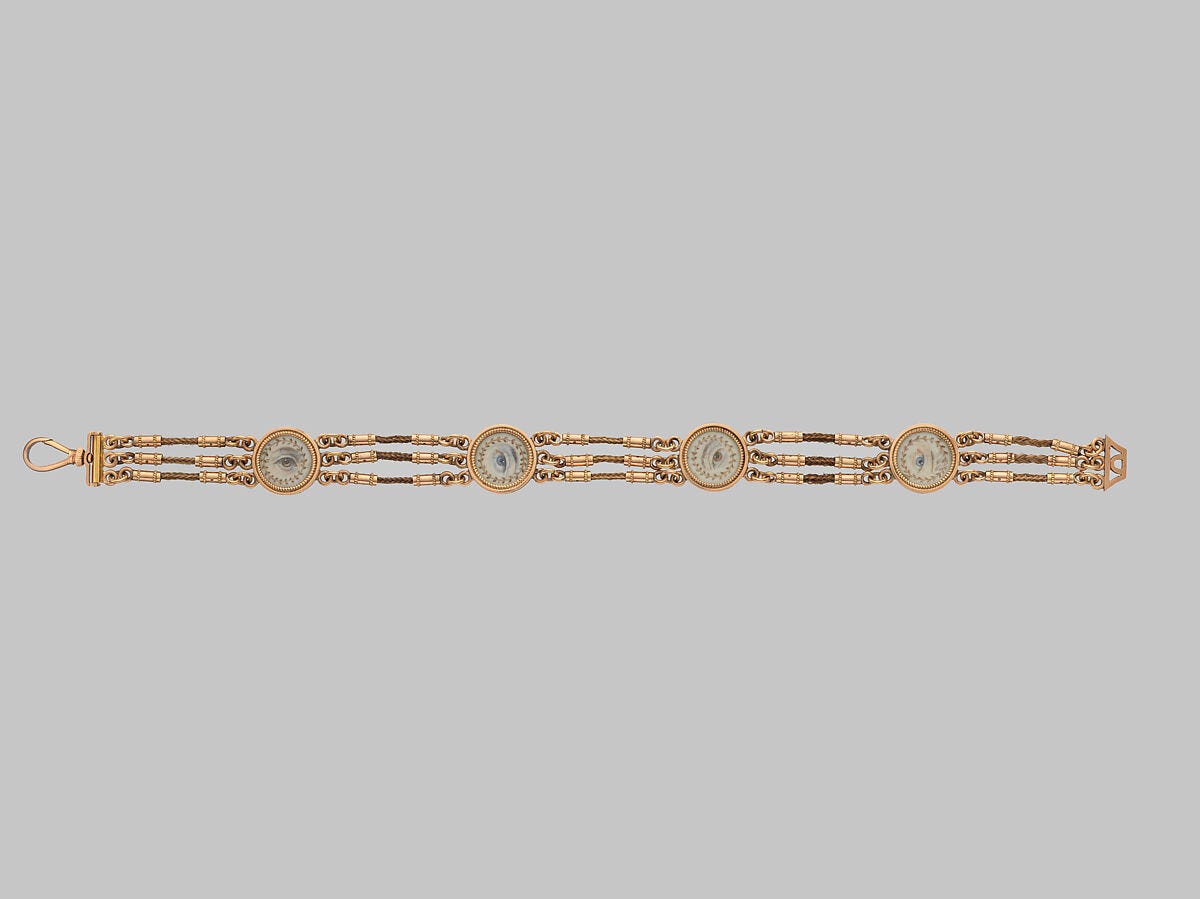
As objects, these tiny and wearable trinkets are part portrait and part jewel. Taking the form of a miniature makes these pieces easy to carry, to hold, and to possess. You can attach this part of another onto yourself and carry it with you. That also made them the perfect keepsake of secret love affairs. Lover’s Eyes transcend both portraiture and jewelry and become something sacred. While all portraits of a loved one can be romantic or sentimental, to crop a portrait to merely an eye specifically signifies the gaze. Hanneke Grootenboer, author of Treasuring the Gaze: Intimate Vision in Late Eighteenth-Century Eye Miniatures, talks about at a time before photography, “people were desperate to give each other not just images of themselves, but part of themselves.” Grootenboer says, “It is the look that someone wants to imagine, and wants to feel as resting upon themselves.” In 18th century British society, public interaction between men and women was not socially acceptable. Looks became a way of communicating what words could not (these social limitations also triggered the phenomena of peeping during this time). Eye miniatures were popularized at a time when the gazing eye dominated social dynamics. More than likely, in addition to Lover’s Eyes being expressions of adoration and devotion, some were commissioned to serve as a type of surveillance as well. A woman would carry her lover’s eye in his absence to remind her that he was always watching.
Over time, the jewels that decorated a Lover’s Eye also became symbolic.
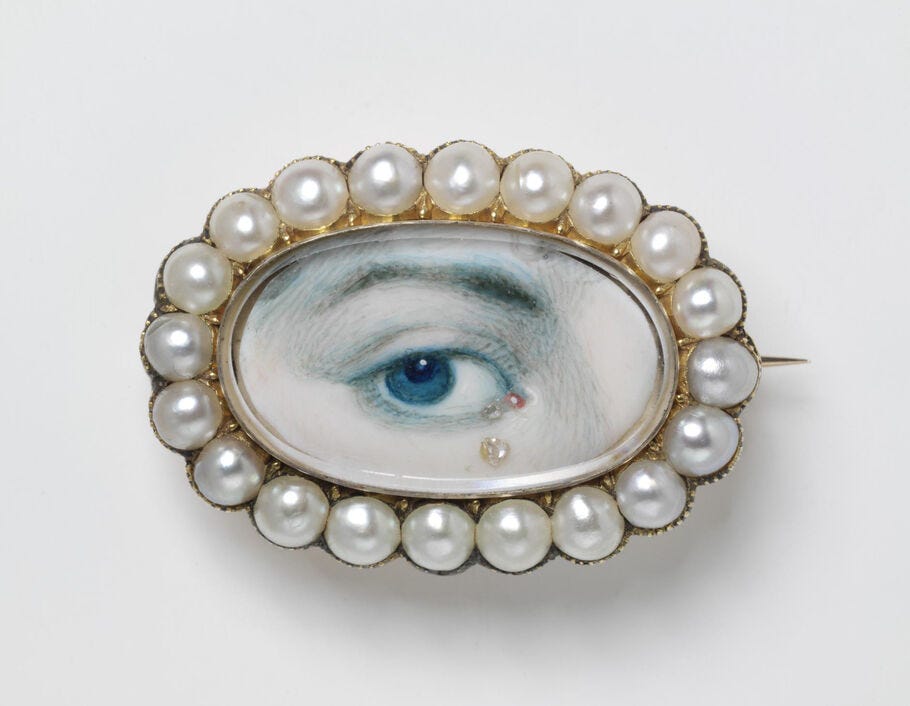
According to Lover’s Eyes, an essay by Graham Boettcher, pearls meant purity, innocence, humility, and tears. The tears often meant that the subject had passed away.
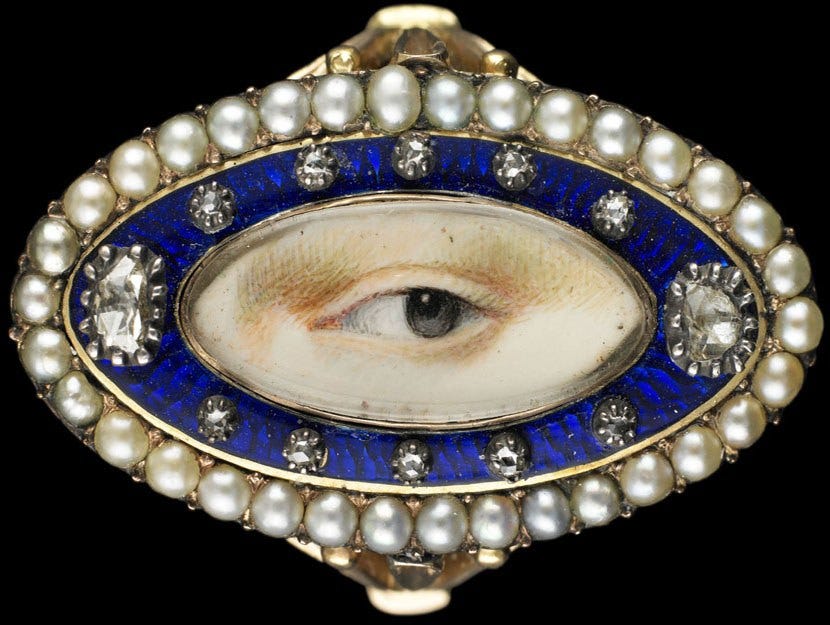
Diamonds represented life, joy, strength, fortitude and longevity.
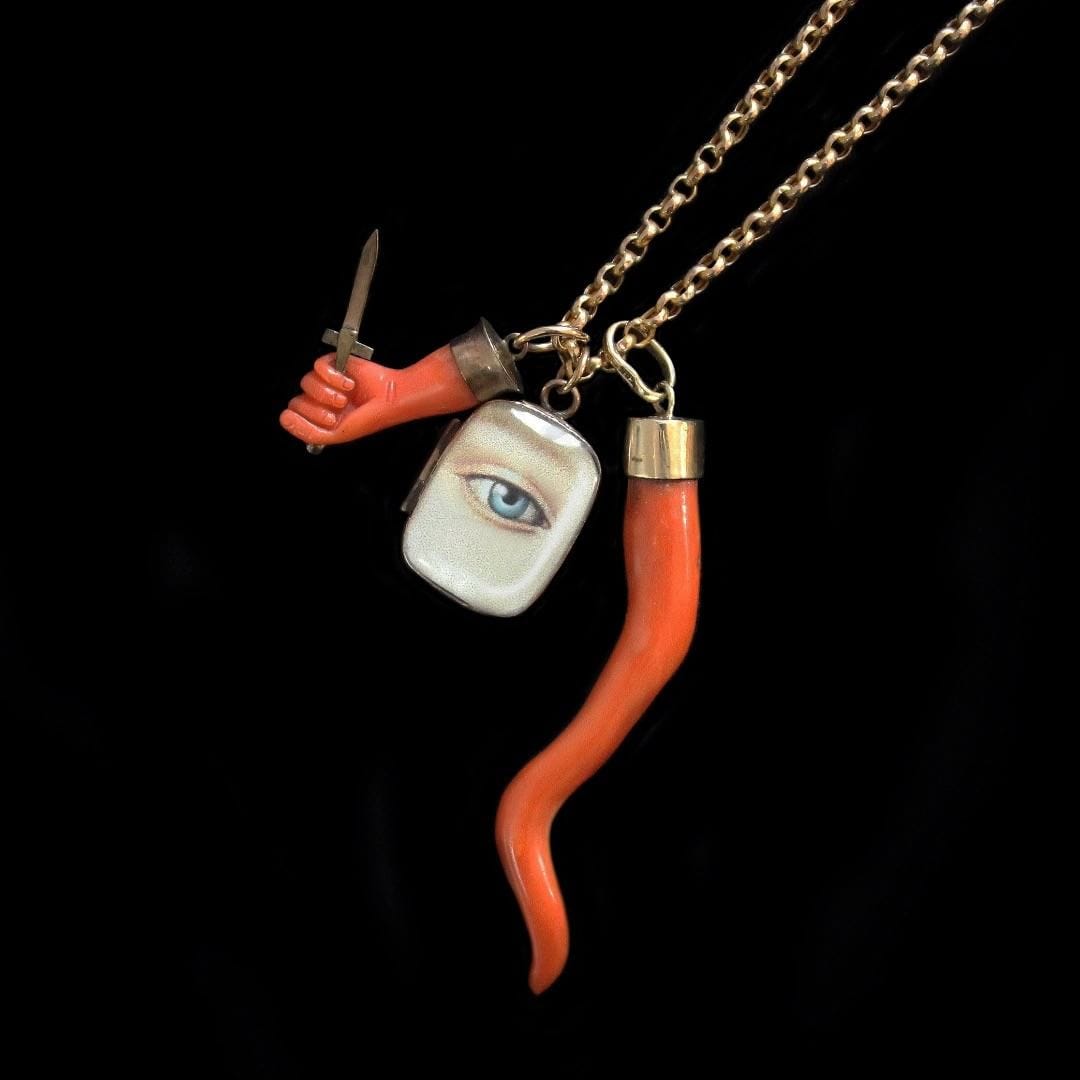
Coral protected the wearer from misfortune and harm.
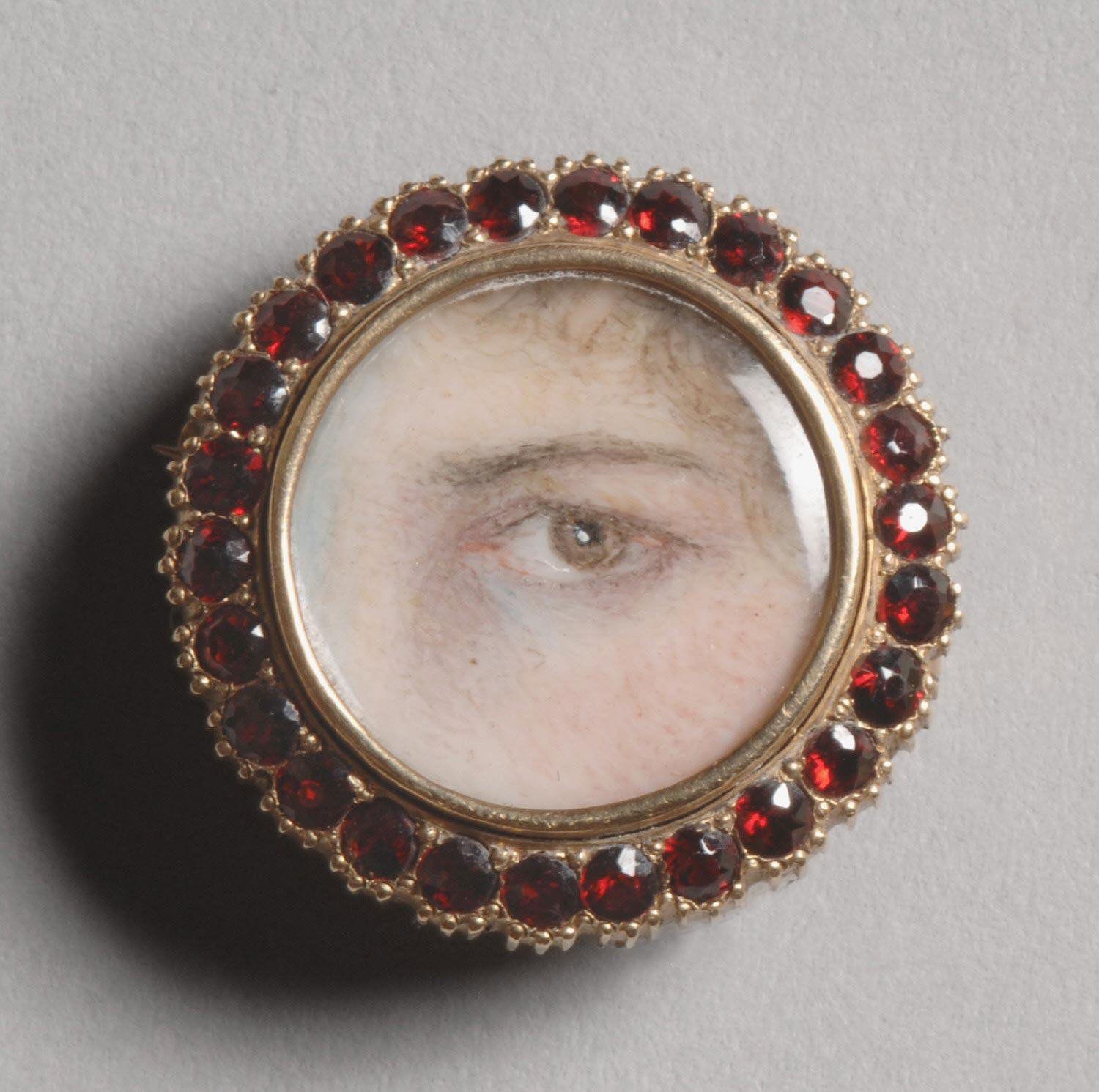
Garnet represented felicity, constancy and friendship.
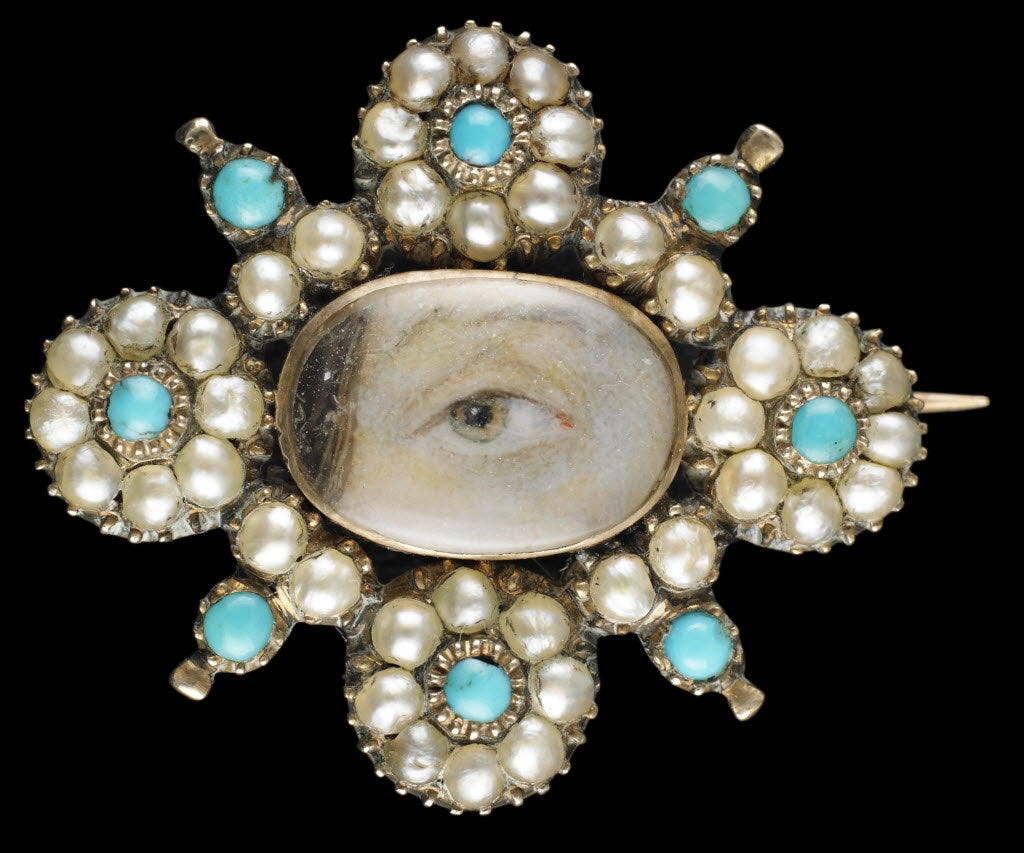
Turquoise, which was rare and expensive, represented riches and changed color according to health.
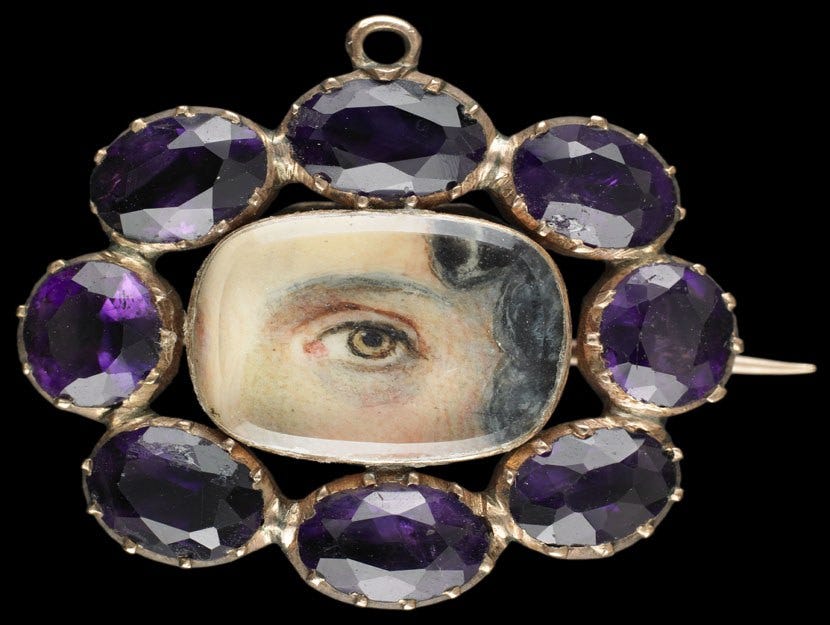
Amethyst symbolized faith, protection, sincerity, and trust unto death.
And so on.
In 1828, a miniature painter herself took the trend to the next level.
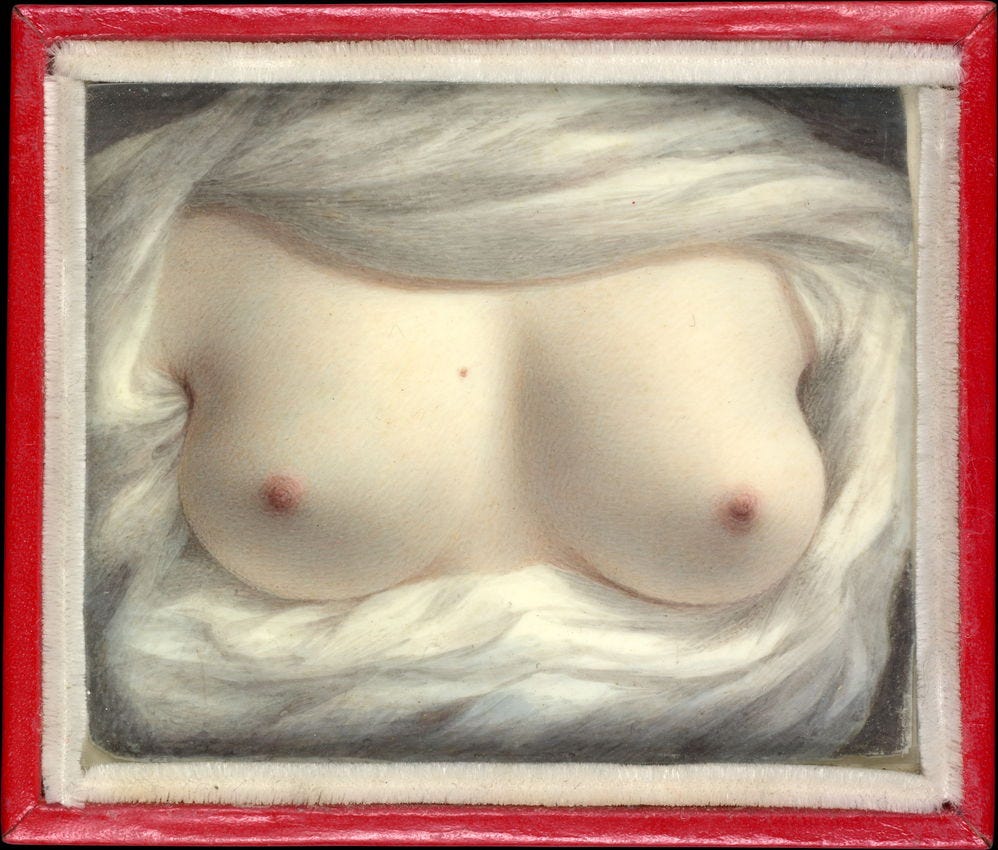
Sarah Goodridge, an accomplished miniaturist, painted her own breasts wrapped in silk on a piece of ivory measuring only 2.6” x 3.1” and enclosed in a leather case. She then sent the piece to her lover, a recently widowed US senator, Daniel Webster.
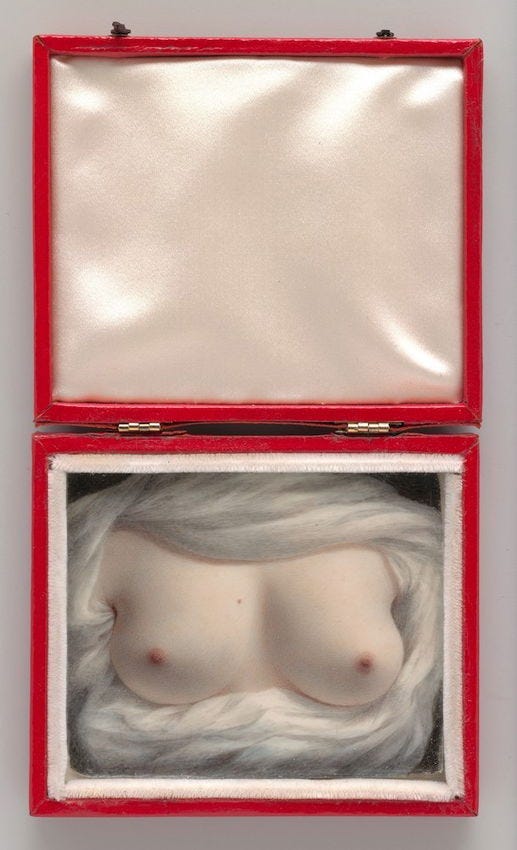
Goodridge and Webster’s relationship began a year earlier in 1827 and would last until Webster’s death in 1852. They rarely saw each other throughout their relationship - Webster visited Goodridge in Boston several times to commission her to paint his family’s portraits. Goodridge visited Webster twice - once in 1828 after the death of his first wife and again in 1841 when he was separated from his second wife. Webster kept Goodridge’s Beauty Revealed until his death, when it was then donated to the Metropolitan Museum of Art.
While Lover’s Eyes acted as a substitute for the gaze of the absent beloved, Goodridge’s Beauty Revealed acted as the equivalent of a nude or a sext - clearly meant to arouse. John Updike wrote in his 1993 essay “The Revealed and the Concealed” that Goodridge most likely sent Webster Beauty Revealed as an erotic offer - an offer that Webster did not take. In 1829, he instead courted the wealthy Catherine Van Renssalaer, and after that, the wealthy Caroline Le Roy. Goodridge, however, stayed single for her entire life. Some speculate that Goodridge’s self-portrait was not only a sexual offering, but also evidence of a woman who embraced the eroticism of her body as well as her role as a mistress.
By 1830, the Lover’s Eye trend was over. Photography emerged and miniature portraiture became obsolete. Many museums collect Lover’s Eyes, including the Metropolitan Museum of Art and the Philadelphia Museum of Art, but little is known about the stories behind them. Despite their anonymity, these trinkets remain incredibly striking, both in aesthetic and craftsmanship.
Lover’s Eyes possess such an erotic quality as adorned portraits conveying the desire of a gaze. So compact that whether one is hidden in a pocket or displayed around a neck, it can always be grasped for.
Sources:
https://publicdomainreview.org/collection/eye-miniatures/
https://publicdomainreview.org/collection/sarah-goodridges-beauty-revealed-1828/
https://www.artsy.net/article/artsy-editorial-mysterious-history-lovers-eye-jewelry
https://www.nytimes.com/2012/02/03/arts/design/loving-lovers-eyes-and-loving-cereal.html
https://news.artnet.com/art-world/lovers-eye-jewel-history-2156398
https://www.downsideabbey.co.uk/george-iv-mrs-fitzherbert/
https://en.wikipedia.org/wiki/George_IV
https://susannahcarson.com/blogs/the-storied-life/a-brief-history-of-lovers-eye-jewelry?srsltid=AfmBOooKjr9kNEPXmVf9Wlg3pHDV5RehTykZe8dAupeZOtFpwtZayFS_
https://www.metmuseum.org/art/collection
https://katieconsiders.com/2018/06/05/miniature-lovers-eye-jewelry/
https://waltonsjewelry.com/blogs/style/lovers-eye-jewelry-the-tiny-windows-of-secret-love?srsltid=AfmBOoqQkVZ89J8tQ7NfDFaaeGf0Wezko8ckdVwlkT799FJfqbT7hPhZ
Boettcher, G. (2021). Lover’s Eyes. In Lover’s Eyes: Eye Miniatures from the Skier Collection. essay.
I loved this! The part about the lock of hair of one’s lover is thrilling and connected to the beyond.
Thank you!
Well....
I found that fascinating, and beautiful, and sad
Just like life.
Deep thanks for this. Although I love antiques for what they tell us about the past, I have never come across "Lover's Eyes" before.
This was wonderful!
Best Wishes - Dave :)